

 English
 русский
Everything You Should Know About Tungsten Carbide Stamping Dies Before You Buy
Industry News-Content
- 1 What Is a Tungsten Carbide Stamping Die and How Does It Work?
- 2 Why Tungsten Carbide Outperforms Tool Steel in Stamping Dies
- 3 Tungsten Carbide Grades Used in Stamping Dies
- 4 Types of Tungsten Carbide Stamping Dies and Their Applications
- 5 How Tungsten Carbide Stamping Dies Are Manufactured
- 6
- 7 Key Design Considerations for Carbide Stamping Die Tooling
- 8 Maintaining and Reconditioning Tungsten Carbide Stamping Dies
- 9 Industries That Rely Most Heavily on Tungsten Carbide Stamping Dies
- 10 Tungsten Carbide Stamping Die vs. Tool Steel Die: Total Cost of Ownership
- 11 How to Source and Specify a Tungsten Carbide Stamping Die
What Is a Tungsten Carbide Stamping Die and How Does It Work?
A tungsten carbide stamping die is a precision tooling component used in metal stamping operations to cut, form, pierce, bend, or emboss sheet metal and other materials into specific shapes. The die is made from tungsten carbide — a composite material consisting of tungsten and carbon atoms sintered together with a metallic binder, most commonly cobalt — which gives it an extraordinary combination of hardness, wear resistance, and compressive strength that conventional tool steel simply cannot match.
In a typical stamping press setup, the tungsten carbide die set consists of two main components: the punch (which applies force) and the die block (which provides the shaped cavity or cutting edge). As the press cycles, the punch drives material into or through the die to produce the desired feature — a hole, a contour, a formed flange, or a blanked part. Because tungsten carbide tooling maintains its edge geometry under millions of cycles without significant wear, it is the preferred choice for high-volume, tight-tolerance stamping applications across industries ranging from automotive to electronics.
Why Tungsten Carbide Outperforms Tool Steel in Stamping Dies
The decision to use a tungsten carbide stamping die over a conventional D2, M2, or H13 tool steel die comes down to one fundamental factor: total cost per part over the life of the tooling. While carbide dies carry a significantly higher upfront cost, their performance characteristics translate to lower per-piece costs at scale. Here's what makes the material difference so dramatic:
- Extreme hardness: Tungsten carbide typically achieves a hardness of 85–93 HRA (Rockwell A scale), compared to 60–65 HRC for hardened tool steels. This means cutting edges and forming surfaces resist deformation under repeated impact loading far more effectively.
- Superior wear resistance: Carbide dies last anywhere from 5 to 50 times longer than equivalent steel dies depending on the application, material being stamped, and die geometry. In high-volume progressive die stamping of abrasive materials, this extended service life is the primary economic justification for carbide tooling.
- Dimensional stability: Unlike steel dies that can deflect or deform under sustained press tonnage, tungsten carbide maintains its shape with minimal elastic deformation, producing more consistent part dimensions across very large production runs.
- Temperature resistance: Carbide retains its hardness at elevated temperatures better than steel, which is important in high-speed stamping where friction generates significant heat at the die interface.
- Low coefficient of friction: The smooth, dense surface of polished carbide reduces galling and adhesion between the die and stamped material, particularly when working with stainless steel, aluminum, or coated sheet metals.
The trade-off is brittleness. Tungsten carbide has significantly lower toughness than steel, which means it is more susceptible to cracking from shock loading, lateral forces, or improper press alignment. This makes die design, press setup, and maintenance practices more critical when working with carbide tooling than with steel alternatives.
Tungsten Carbide Grades Used in Stamping Dies
Not all tungsten carbide is the same. The grade of carbide selected for a stamping die directly determines how the die performs, how long it lasts, and what failure modes it's most vulnerable to. Carbide grades are differentiated primarily by grain size and cobalt binder content — two variables that create a direct trade-off between hardness and toughness.
Cobalt Content and Its Effect on Die Performance
Cobalt is the metallic binder that holds tungsten carbide grains together. Higher cobalt content (10–25%) increases toughness and impact resistance but reduces hardness and wear resistance. Lower cobalt content (3–8%) produces a harder, more wear-resistant die that is also more brittle. For stamping die applications, cobalt content typically falls in the 8–15% range — a balance point that delivers adequate toughness for press impact while maintaining the wear resistance that justifies using carbide in the first place. Punching dies that experience higher shock loads tend to use higher cobalt grades, while blanking and trimming dies working at slower press speeds can use lower cobalt grades for maximum edge retention.
Grain Size and Surface Finish Quality
Tungsten carbide grain size ranges from submicron (under 0.5 µm) to coarse (over 3 µm). Fine and ultrafine grain carbides are harder and can be ground and polished to tighter surface finishes — important for dies that produce precision blanked parts with tight burr requirements or fine-feature forming. Coarse grain carbides are tougher and more forgiving under intermittent loading but cannot achieve the same level of surface finish. Most stamping die applications use fine to medium grain carbide (0.5–1.5 µm) as the optimal balance between surface quality and impact resistance.
Common Carbide Grades by Application
| Carbide Grade | Co Content | Hardness (HRA) | Best For |
| YG6 / K10 | 6% | 91.5–92.5 | Blanking dies, precision trimming |
| YG8 / K20 | 8% | 90.5–91.5 | General stamping, medium-speed presses |
| YG11 / K30 | 11% | 89.5–90.5 | Progressive dies, punching operations |
| YG15 / K40 | 15% | 87.0–89.0 | Heavy-duty forming, deep drawing |
| Ultrafine grain | 8–10% | 92.0–93.5 | Micro-stamping, electronics parts |
Types of Tungsten Carbide Stamping Dies and Their Applications
Tungsten carbide stamping dies are used across a wide range of press operations, each with different design requirements and performance expectations. Understanding which die type applies to your process helps you specify the right carbide grade and geometry.
Carbide Blanking and Piercing Dies
Blanking dies cut flat shapes from sheet metal stock, while piercing dies punch holes through material. Both operations require extremely sharp, precise cutting edges that maintain their geometry over millions of strokes. Tungsten carbide is ideal here because its hardness prevents edge rounding and chipping that would cause burr height to increase over time — a critical quality parameter in industries like automotive stamping and electrical contact manufacturing. Clearances between punch and die in carbide blanking tooling are typically tighter than steel equivalents (2–5% of material thickness per side), which produces a cleaner shear face and finer burr.
Carbide Progressive Stamping Dies
Progressive stamping dies perform multiple operations — blanking, piercing, bending, forming — in a single die set as the strip material advances through successive stations. Carbide inserts are used in the highest-wear stations of the progressive die rather than building the entire die from carbide, which would be prohibitively expensive and structurally challenging. This hybrid approach places carbide cutting and forming inserts in steel die shoes and retainers, combining carbide's wear resistance with steel's toughness and machinability for structural components. Progressive carbide dies are widely used in the production of electronic terminals, connector pins, and automotive components such as spring clips and brackets.
Carbide Drawing and Forming Dies
Deep drawing dies shape flat sheet metal into three-dimensional cup or shell forms by forcing material over a punch and through a die ring. The die radius and inner bore surface experience intense frictional sliding contact with the workpiece, making wear resistance essential. Tungsten carbide drawing dies maintain their surface finish and dimensional accuracy over far longer production runs than steel equivalents, producing consistent drawn part wall thickness and surface quality throughout. They are used extensively in the production of battery cans, cartridge casings, beverage cans, and medical device housings.
Carbide Embossing and Coining Dies
Embossing and coining operations use very high press forces to impart precise surface features, textures, or dimensional accuracy to a workpiece. Coining in particular uses pressures that fully plastic-flow the material to achieve extremely tight tolerances. Tungsten carbide coining dies withstand these extreme compressive loads without deforming, making them standard in the production of coins, medallions, electrical contacts, and precision mechanical parts where surface detail and dimensional consistency are paramount.
How Tungsten Carbide Stamping Dies Are Manufactured
Manufacturing a tungsten carbide stamping die is a precision process that requires specialized equipment and expertise significantly beyond what conventional die shops can offer. The key stages involved are:
- Powder metallurgy and sintering: Tungsten carbide starts as a fine powder blended with cobalt binder and compacted into a green body using pressing or extrusion. The compact is then sintered at temperatures around 1400–1500°C to fuse the grains into a dense, hard blank. The sintered blank is oversize to allow for finish grinding.
- EDM (Electrical Discharge Machining): Because carbide is too hard to machine with conventional cutting tools, complex internal profiles and fine features are produced using wire EDM or sinker EDM. Wire EDM cuts through the carbide blank using an electrically charged wire to erode material with extreme precision — tolerances of ±0.002 mm are routinely achievable. This is the primary shaping process for carbide die profiles.
- Diamond grinding: External surfaces, mounting faces, and critical clearance dimensions are finish-ground using diamond abrasive wheels. Diamond is the only abrasive hard enough to efficiently machine tungsten carbide to the surface finish and dimensional accuracy required for precision stamping dies.
- Lapping and polishing: For drawing dies and coining dies where surface finish directly affects part quality, carbide surfaces are lapped and polished to mirror finishes (Ra 0.02–0.1 µm) using diamond lapping compounds. This minimizes friction and prevents workpiece surface damage during stamping.
- Assembly and shrink fitting: Carbide die inserts are frequently assembled into steel housings using interference fits — the carbide insert is pressed or shrink-fitted into a steel retaining ring that applies radial compressive stress to the carbide, counteracting tensile stresses generated during stamping that could otherwise cause cracking.
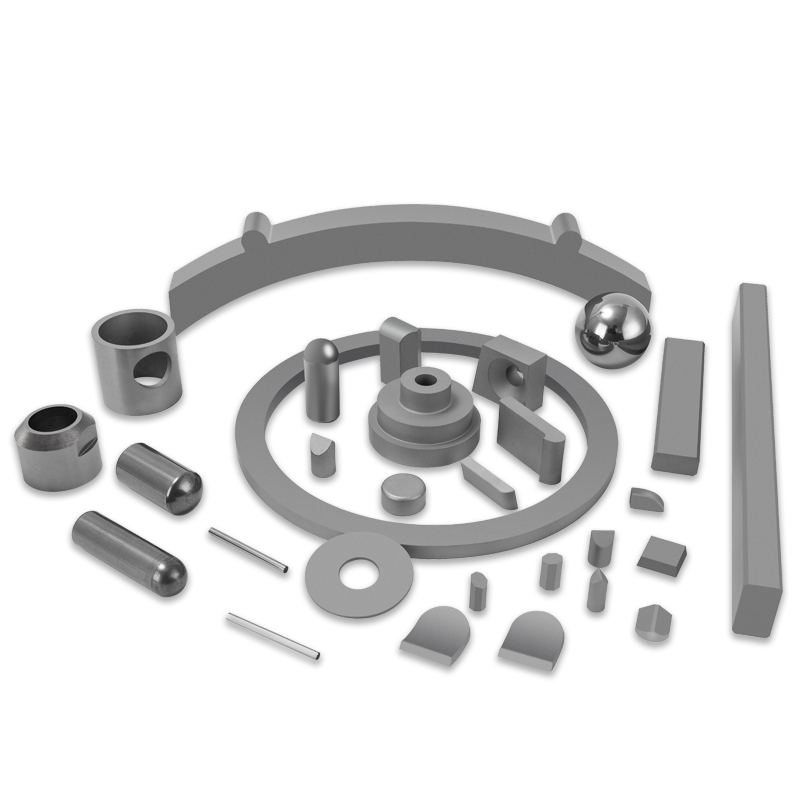
Key Design Considerations for Carbide Stamping Die Tooling
Designing a tungsten carbide stamping die correctly from the outset is critical — carbide's brittleness means design errors that would merely shorten steel die life can cause catastrophic carbide fracture. The following design principles are essential:
Avoid Sharp Internal Corners
Sharp corners in carbide die sections act as stress concentration points. Any internal corner in a carbide die should be radiused — even a small radius of 0.1–0.3 mm significantly reduces the stress concentration factor and dramatically improves resistance to cracking under cyclic press loads. This is one of the most common causes of premature carbide die failure in dies that were designed with tool steel tolerances in mind without adapting for carbide's brittleness.
Proper Punch-to-Die Clearance
Clearance between the carbide punch and die block must be carefully controlled. Too little clearance increases cutting forces and introduces lateral loading that can chip carbide cutting edges. Too much clearance produces excessive burr and poor cut-face quality. For typical carbon steel sheet, carbide blanking dies use 2–4% of material thickness per side; for stainless steel, 3–5%; for aluminum, 4–6%. These tighter clearances compared to steel dies require more precise press alignment and parallelism.
Adequate Support and Retention
Carbide die sections must be fully supported across their bottom and sides to prevent bending stresses. Steel retaining rings should be designed to apply uniform compressive prestress to the carbide insert. Any rocking or tilting of a carbide insert under press load will generate bending tensile stresses that can crack the material. Proper die shoe flatness, insert seat geometry, and fastener placement are all part of achieving adequate support.
Maintaining and Reconditioning Tungsten Carbide Stamping Dies
Tungsten carbide stamping dies require less frequent maintenance than steel dies, but when maintenance is needed, it must be performed with the right equipment and techniques. Improper reconditioning can destroy expensive carbide tooling.
- Sharpening and re-grinding: When carbide cutting edges dull or chip after extended service, they can be re-ground using diamond grinding wheels. The amount of material removed per sharpening cycle is typically 0.05–0.15 mm from the cutting face. Most carbide dies can be sharpened multiple times before the die section becomes too thin to use safely — tracking cumulative material removal is essential.
- Inspection for microcracking: Before and after re-grinding, carbide die sections should be inspected for surface and subsurface cracks using dye penetrant testing or magnetic particle inspection (for cobalt-bonded carbide). Cracks that are not detected before a die is returned to service can propagate rapidly and cause catastrophic fracture in the press.
- Never use abrasive wheels not rated for carbide: Using aluminum oxide or silicon carbide grinding wheels on tungsten carbide generates excessive heat and can introduce grinding cracks. Only diamond abrasive wheels should be used, with adequate coolant flow to prevent thermal damage.
- Lubrication during stamping: Applying appropriate stamping lubricant reduces friction at the die face and extends service life between sharpenings. For drawing dies in particular, consistent lubrication is essential to prevent adhesive wear and galling on the polished carbide bore surface.
- Storage handling: Carbide dies should be stored in padded containers or on foam-lined shelves and never stacked directly against other metal tooling. Even minor impacts can chip precision carbide edges, requiring re-grinding before the next production run.
Industries That Rely Most Heavily on Tungsten Carbide Stamping Dies
Tungsten carbide stamping dies are found across virtually every sector that produces precision metal parts at volume. The following industries represent the highest-demand applications:
- Automotive manufacturing: From engine components and transmission parts to body brackets, spring clips, and electrical terminals, automotive stamping operations run at high speeds with tight tolerances and zero tolerance for quality variation. Carbide progressive dies are standard in Tier 1 and Tier 2 automotive supplier plants.
- Electronics and electrical components: Connector pins, lead frames, EMI shielding components, and battery contacts are produced in extremely high volumes — often billions of parts annually — from thin-gauge copper, brass, or stainless steel. The fine feature sizes and volume demands make carbide the only viable tooling material.
- Medical device manufacturing: Precision surgical instruments, implantable component parts, and diagnostic device housings require extremely tight dimensional tolerances and contamination-free surfaces. Carbide stamping dies meet these requirements while providing the long tool life necessary for cost-effective production.
- Aerospace and defense: Aerospace stampings in aluminum alloys, titanium, and high-strength steels subject tooling to extreme abrasive wear. Carbide dies are specified for critical aerospace components where dimensional consistency must be maintained across long production runs without deviation.
- Coin and currency production: Government mints worldwide use tungsten carbide coining dies to produce coins with the fine surface detail, dimensional accuracy, and production volumes that only carbide tooling can reliably sustain.
Tungsten Carbide Stamping Die vs. Tool Steel Die: Total Cost of Ownership
The most common objection to carbide stamping dies is their initial cost — a carbide die can cost 3 to 10 times more than an equivalent tool steel die. However, evaluating tooling purely on upfront cost is a flawed approach. The correct metric is cost per stamped part over the life of the tooling, accounting for all relevant factors:
| Cost Factor | Tool Steel Die | Tungsten Carbide Die |
| Initial tooling cost | Low | High (3–10× steel) |
| Typical service life | 50,000–500,000 parts | 1M–50M+ parts |
| Re-sharpening frequency | Frequent | Infrequent |
| Downtime for tool changes | High | Low |
| Part quality consistency | Degrades over time | Maintained over long runs |
| Scrap rate over time | Increases as die wears | Remains low throughout |
| Cost per part (high volume) | Higher | Lower |
For production runs above approximately 500,000 parts, tungsten carbide stamping dies almost always deliver a lower total cost of ownership than tool steel alternatives. Below that volume threshold, the calculus depends on the material being stamped, the complexity of the die geometry, and how critical part quality consistency is to the application.
How to Source and Specify a Tungsten Carbide Stamping Die
Sourcing a carbide stamping die requires working with a tooling supplier that has specific expertise in carbide — not every die shop does. When evaluating suppliers and specifying your tooling, keep the following in mind:
- Provide complete material and process data: Give your supplier the workpiece material specification (grade, temper, thickness, and surface coating if any), press type and tonnage, cycle rate, and part tolerance requirements. These parameters directly determine the appropriate carbide grade, clearance values, and surface finish specification.
- Request material certification: A reputable carbide die supplier will provide material test certifications confirming carbide grade, hardness, and density for each die section. This documentation is essential for quality assurance and troubleshooting if issues arise during production.
- Specify inspection requirements: Define the critical dimensions, surface finish parameters, and inspection methods required before accepting the die. For tight-tolerance blanking dies, this typically includes CMM dimensional verification, surface roughness measurement, and edge integrity inspection under magnification.
- Discuss reconditioning support: Ask your supplier whether they offer die re-grinding and reconditioning services, and what their lead time and pricing looks like. Having a supplier relationship that covers the full die lifecycle — from initial manufacture through reconditioning — simplifies tooling management significantly.
- Consider spare die sections: For critical production operations where die failure would cause significant downtime, ordering a spare carbide insert or punch alongside the primary tooling is often a cost-effective insurance policy — particularly given the lead time for precision carbide components.
Our Products //
Related Products

If you are interested in our products, please consult us
