

 English
 русский
Tungsten Carbide Die Guide: Types, Grades, Design and Application Tips
Industry News-If you spend your working day around presses, cold headers, or drawing benches, you already know what a difference a good die makes. A tungsten carbide die can run for hundreds of thousands of strokes before it needs attention, which is exactly why so many manufacturers now specify carbide for their most demanding forming and cutting operations. Our company has been producing cemented carbide parts in Changzhou since 1990, and in this article we would like to share what we have learned about what these dies are, how they are made, and how to get the longest possible service life from them.
Content
What Is a Tungsten Carbide Die?
A tungsten carbide die is a tool whose working cavity or cutting edge is made from cemented carbide rather than tool steel. The material is a composite: hard tungsten carbide grains are cemented together by a softer metallic binder, usually cobalt. It is produced by blending powder, pressing it into a shape close to the finished part, and sintering it at roughly 1,400 degrees Celsius, after which the blank is ground and polished to its final dimensions.
Two properties make carbide so attractive for dies. The first is hardness, typically between 1,400 and 1,900 HV, several times that of hardened tool steel, which translates into outstanding wear resistance against abrasive sheet, wire, and strip. The second is compressive strength, which allows a cavity to withstand the enormous pressure of a stamping or drawing operation without collapsing.
Carbide is not, however, as tough as steel. Its tensile and impact strength are limited, so a die insert is almost always mounted in a steel casing, a shrink ring, or a bolster that keeps the carbide in compression and absorbs shock. Understanding that partnership between the carbide insert and its steel housing is the first step toward a die that lasts.
How a Tungsten Carbide Die Is Made
Every die starts as powder. The particle size of the tungsten carbide, the cobalt content, and the pressing and sintering cycle together determine the final balance between hardness and toughness. Production normally follows a sequence like this:
- Powder preparation. Tungsten carbide powder is milled and blended with cobalt and small amounts of grain-growth inhibitors, then spray dried into free-flowing granules.
- Pressing. The granules are compacted in a die or an isostatic press into a green part that is deliberately larger than the finished component, because sintering will shrink it.
- Sintering. The part is heated in a vacuum or low-pressure furnace, where the cobalt becomes liquid and pulls the carbide grains together into a dense body with almost no porosity.
- Finishing. Diamond grinding, wire EDM, lapping, and polishing bring the cavity to tolerances measured in microns.
- Assembly. The carbide insert is pressed or shrunk into its steel ring, and the finished die is inspected for concentricity, hardness, and surface finish.
Equipment matters enormously at these stages. When we invested in low-pressure sintering furnaces and TPA presses in 2009, it was precisely because consistency in pressing and sintering is what separates a die that holds its dimensions for years from one that drifts after a few months.
Common Types of Tungsten Carbide Dies
Although the word "die" is used loosely in workshops, the products themselves fall into recognizable families. The table below summarizes the most common ones and the conditions each has to survive.
| Die type | Typical process | Workpiece | Key requirement |
|---|---|---|---|
| Blanking and stamping die | Sheet blanking, piercing, forming | Steel, aluminium, copper strip | Edge retention, controlled clearance |
| Drawing die | Wire, bar, and tube drawing | Ferrous and non-ferrous metal | Polished bore, wear resistance |
| Extrusion die | Cold forward and backward extrusion | Aluminium, copper, steel billets | High compressive strength |
| Cold heading die | Fastener and rivet forming | Carbon and alloy steel wire | Impact resistance, fatigue life |
| Powder compacting die | Compaction of metal or ceramic powder | Prepared powder mixes | Abrasion resistance, clean release |
Blanking and stamping work is the largest single application in our own order book. A carbide stamping die is normally built as a ground and polished insert pressed into a hardened steel ring, with the geometry arranged so that the working load keeps the carbide in compression.
 Tungsten Carbide Stamping Die for Wear-Resistant BlankingBuilt for blanking and stamping, this tungsten carbide die offers wear resistance, high-temperature performance, and precision needed to maintain die accuracy and support efficient production.View Product →
Choosing the Right Carbide Grade
There is no single best grade for every die. Selection comes down to a few variables that pull against each other:
- Cobalt content. A low binder content of around 6 percent gives maximum hardness and wear resistance, which suits high-volume blanking of thin sheet. A higher content of 12 to 20 percent trades some hardness for toughness and is the better choice when the die sees heavy impact.
- Grain size. Submicron grades hold a keener edge and resist abrasive wear, while medium and coarse grades absorb shock more gracefully. Fine grain is not automatically better; it is simply better matched to light, fast, clean cutting.
- Surface condition. A polished bore reduces friction in drawing and extrusion, while selected forming tools benefit from surface treatments where galling is a problem.
- Working temperature. When the workpiece is hot rather than cold, thermal cycling adds another dimension to grade selection, and the advantages of tungsten carbide dies in hot stamping applications deserve their own discussion.
A practical rule is to choose the lowest cobalt content and the finest grain size that will still survive the impact of your press. Testing both directions with a supplier is far cheaper than discovering the limit in production.
Design Details That Decide Die Life
Many premature failures we are asked to investigate are not material problems at all; they are design or setup problems. The points below account for most of them.
- Clearance. Too little clearance chips the cutting edge, too much produces burrs and rolled edges. Carbide generally prefers slightly more clearance than steel.
- Support. Never leave carbide unsupported in tension. Shrink rings and backing plates should place the insert in compression under load.
- Entry geometry. A small lead-in radius or chamfer guides the workpiece and prevents the edge from taking the full load at once.
- Alignment. Press parallelism, die-set guidance, and ram alignment affect the die as much as the die affects the part.
- Lubrication. Adequate lubrication controls friction heat and reduces galling on the carbide surface.
Maintenance Practices That Pay Off
Carbide dies are durable, but they are not indestructible, and small habits make a large difference over the life of a tool.
- Inspect the working edges at fixed intervals instead of waiting for a quality problem to appear.
- Record stroke counts and regrinding history so that wear can be predicted rather than discovered.
- Remove slivers, burrs, and debris before they mark the cavity or the strip.
- Re-lap or regrind in small, controlled steps, since every regrind consumes part of the available edge.
- Store dies with a light protective film and a ring that guards the bore or the cutting edge.
A die that is maintained on schedule usually delivers far more strokes per insert than one that is repaired only after it fails.
Working With a Die Maker Who Understands Your Process
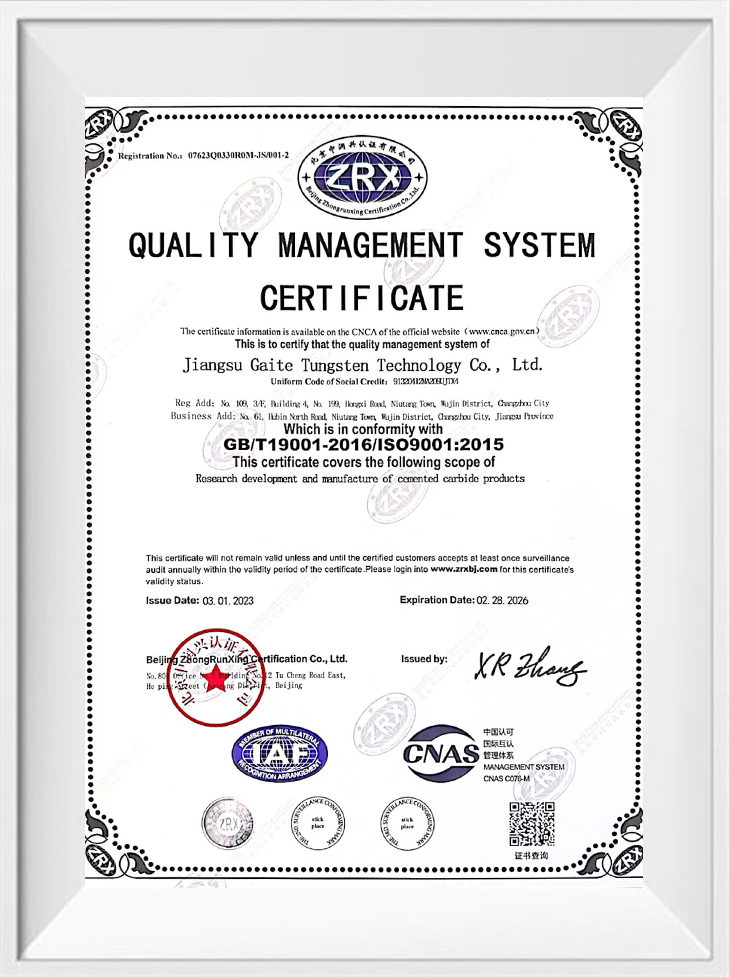
Because we press, sinter, and grind our own carbide, we can control the variables that decide whether a die performs on your press. Our production is organized under ISO 9001 and ISO 14001 management systems, and our precision tooling is manufactured to internationally recognized standards for dimensional accuracy and batch consistency.
That vertical control matters for dies, because a small change in binder content or sintering cycle shows up directly in die life. Beyond forming dies, we also produce the cutting side of the process, including blades for trimming, shearing, and cutting operations made from the same carbide technology, so a customer can source the forming tool and the cutting tool from one partner.
Tungsten Carbide Cutting Blade for Trimming and ShearingMade with the same carbide technology as the company's forming dies, this cutting blade supports trimming, shearing, and cutting operations while helping achieve dimensional accuracy and surface quality.View Product →
If you are still deciding which product family fits your operation, our full range of tungsten carbide products gives a quick overview of everything we build.
In the end, a tungsten carbide die is a simple idea executed with great precision: an extremely hard material, placed in compression, guided by careful design, and maintained with discipline. Get those four things right and the die will quietly pay for itself many times over. If you would like to talk through a specific application, whether it is blanking thin sheet, drawing wire, or forming fasteners, our team is always glad to compare notes with the people who run the presses.
Our Products //
Related Products
If you are interested in our products, please consult us
