

 English
 русский
Tungsten Carbide Road Milling Tools: Practical Advice from Our Shop Floor
Industry News-Road milling is not a gentle application. A planer drum turns at speed, teeth meet abrasive asphalt or concrete, and every unplanned stop costs money. We have spent years making tungsten carbide parts for work like this, and the same lesson keeps coming back: a tool is only as good as the match between carbide grade, steel body, holder fit, and the way the machine is run.
We are Jiangsu Gaite Tungsten Technology, a carbide manufacturer based in Changzhou. Road milling tools sit close to the center of what we do, alongside cutting blades, rock drilling tools, TBM inserts, and stamping dies. That range matters because road milling problems rarely stay inside one category. A wear issue may really be a brazing issue. A broken tip may begin with a loose holder.
If you are comparing tool options for an upcoming project, our road milling tools range is a useful place to start.
 Tungsten Carbide Road Milling ToolsFour carbide grades for road milling teeth, presented with hardness and strength data for comparing wear resistance and impact toughness.View Product →
Content
What a Road Milling Tool Has to Handle
A road milling tool looks simple from the operator's seat: a steel shank, a carbide tip, and a retainer. In service, it is a small wear system. The tip must resist abrasion from aggregate and silica. The braze must hold through impact and heat. The shank must sit securely in the holder while still allowing the tool to rotate as intended. The holder itself must stay clean and round, because a worn bore will shorten the life of any tooth, whatever its carbide grade.
Applications vary more than many people expect. Fine milling for surface texture, deep cuts for full-depth reclamation, bridge deck repair, trenching, and cold planing all ask different things from the same basic tool shape. Asphalt can be abrasive but relatively forgiving. Concrete can be hard, uneven, and reinforced. A tool that works well in one lane may not last in another.
Why Tungsten Carbide Is the Working Edge
Tungsten carbide earns its place because it combines high hardness with useful compressive strength. In road milling, that means the tip can keep a working edge while it is repeatedly loaded and cooled. Cobalt content, grain size, tip geometry, and brazing quality all influence how that hard material behaves in the real world.
There is no universal "best" grade. A wear-resistant grade can hold a sharp edge in abrasive asphalt, but a tougher grade may be the better choice where the drum meets concrete, patch material, or unexpected obstacles. The table below is a starting point for that conversation, not a substitute for job-site trials.
| Job condition | What to favor | Why it matters |
|---|---|---|
| Highly abrasive asphalt, steady depth | Wear-resistant carbide, clean tip geometry | Keeps a sharp edge without overloading the drum |
| Hard concrete, mixed material, possible rebar | Tougher carbide, robust brazing | Handles impact and uneven loads |
| High-speed planing, deep cuts | Balanced grade, secure shank and retainer | Reduces tip stress and tool loss |
| Fine milling and surface texture | Precision tip, stable shank | Supports consistent finish and depth control |
Notice that the table does not separate "good" from "bad" tools. It separates jobs. A grade that lasts in one application can fail early in another if the balance is wrong.
Fit and Holder Condition: The Quiet Cost Savers
We often see tool life discussed as if carbide were the only variable. In the field, holder condition can be just as decisive. A worn holder lets the shank move, the tip takes loads it was not designed for, and breakage follows. A dirty holder prevents proper seating. A damaged retainer lets a tool walk out and disappear into the milled surface.
A simple pre-installation check
- Clean the holder bore and remove compacted fines.
- Check for ovality, scoring, and heat damage.
- Confirm the retainer style and seating depth.
- Match shank diameter and length to the holder and drum.
- Replace worn holders before blaming the tool.
None of these steps takes long. Together, they prevent a surprising share of premature failures.
Running Tips That Add Service Life
Operating habits matter, too. A milling tool is designed to rotate, cut, and clear material. If it is buried too deep, run too slowly, or asked to cut through material that should be removed another way, the carbide cannot do its job. Water spray, when used correctly, helps control dust and temperature. Consistent drum speed and forward rate are more kind to the tool than stop-start operation.
- Match cutting depth and speed to the drum and material.
- Keep water sprays working and aimed as recommended.
- Inspect holders at every tool change, not once a season.
- Rotate spare stock and record wear patterns by job.
- Separate tools by application so a concrete set is not mixed with an asphalt set.
We go deeper into daily care in our article on getting more miles from tungsten carbide road milling tools. It is written for crews who want fewer surprises, not more theory.
When a Standard Tool Is Not Enough
Most road milling work can be covered by standard tool shapes, but not all. Drum configuration, machine model, material, target depth, and the condition of the holder can push a job toward a custom tip geometry, a different braze, or a specific grade. A contractor may also need a tool that balances wear life against penetration rate in a way that off-the-shelf items do not quite match.
This is where a carbide manufacturer's experience with powder, pressing, sintering, and grinding becomes useful. We can discuss the failure pattern, look at the holder and drum, and suggest whether the answer is a different grade, a change in brazing, or a redesign of the tip. Sometimes the honest answer is that the holder needs attention first. We would rather say that than sell a tool that cannot perform.
Quality You Can Trace Back to the Powder
Our work in tungsten carbide began in the early 2000s, when we added technical staff and production equipment to move into hard alloy manufacturing. Since then, we have built a product range that includes cutting blades, TBM inserts, rock drilling tools, round shank picks, stamping dies, and custom parts. Road milling tools benefit from the same production chain: powder preparation, pressing, sintering, brazing, grinding, and inspection.
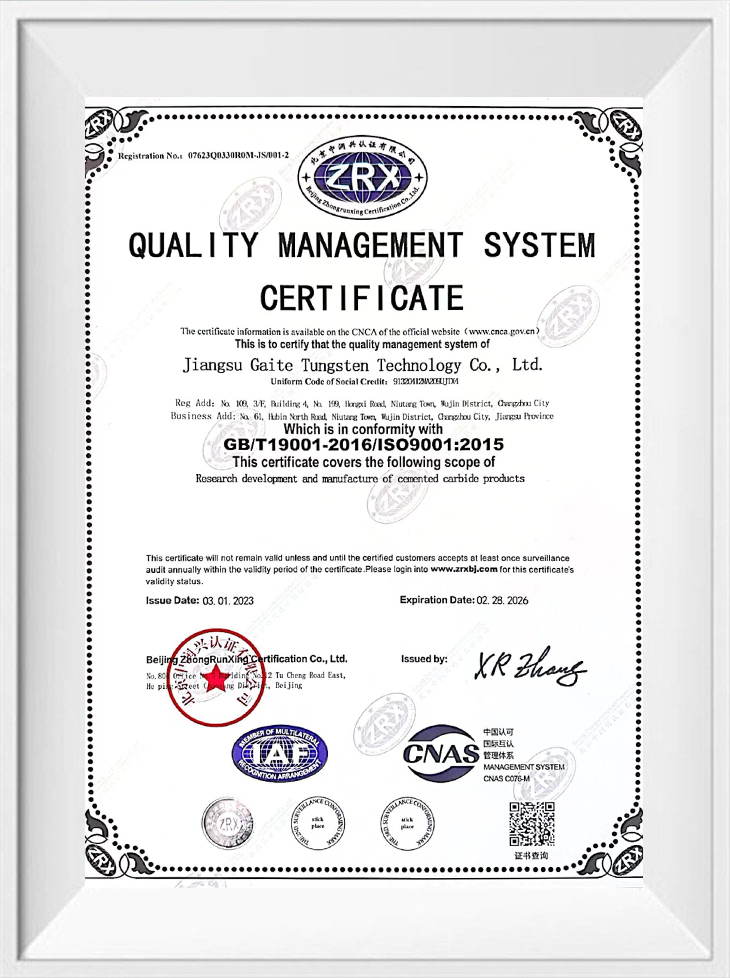
We use low-pressure sintering and TPA pressing equipment, along with five-axis tool grinding and digital tool measurement, to control density, geometry, and edge quality. Our quality system is certified to ISO9001, and our environmental system to ISO14001. Those certificates are not the whole story, but they show that the shop has a system behind the sample. For road milling, the practical result is a tool that can be discussed in terms of grade, braze, fit, and wear pattern rather than guesswork.
A Practical Selection Checklist
Before you request a quote or place an order, gather a few facts. They make the conversation faster and the recommendation more useful.
- Machine make and model, plus drum type.
- Material being milled: asphalt, concrete, or mixed.
- Typical depth of cut and forward speed.
- Holder condition and retainer style.
- Failure pattern: worn tip, broken tip, lost tool, or loose shank.
- Target: longest wear life, fastest cutting, or a balance of both.
Photos help. A close-up of a failed tool and the holder often explains more than a page of description.
Road milling tools are consumables, but they are not disposable in the sense of being unimportant. Every tooth on the drum affects production, fuel use, downtime, and the quality of the finished surface. The right tungsten carbide road milling tool is not the hardest one on the shelf. It is the one whose grade, geometry, braze, and fit suit the road you are cutting and the machine you are running.
If you are planning a project or reviewing a wear problem, we are happy to look at the details with you. That is the part of the work we enjoy: turning a practical problem into a tool that behaves predictably, job after job.
Our Products //
Related Products
If you are interested in our products, please consult us
