

 English
 русский
Tungsten Carbide Rock Drilling Tools: A Practical Guide for Tough Ground
Industry News-Rock drilling rarely rewards guesswork. In a quarry, a tunnel, or a bench blast, the difference between steady progress and a stalled shift often comes down to the cutting edge. Tungsten carbide rock drilling tools are the parts that meet the rock first, and their performance depends on far more than the hardness of the carbide alone.
At Gaite, we have been working with tungsten carbide since the 1990s, and we have learned that a drill bit is a system: carbide grade, insert shape, braze quality, steel body, thread, flushing design, and the drilling method all have to agree. This guide is a practical look at what these tools are, how they behave in different ground, and what to check before you put them to work.
Content
- 1 What Makes Tungsten Carbide Suited to Rock Drilling?
- 2 A Quick Tour of Tungsten Carbide Rock Drilling Tools
- 3 Matching the Tool to the Ground
- 4 Grade, Braze, and Body: The Details That Decide Tool Life
- 5 When the Ground Calls for Something Bigger: TBM Inserts and Mining Picks
- 6 Field Notes: Getting More Life From the Tool
- 7 What to Share With a Supplier
- 8 A Final Word
What Makes Tungsten Carbide Suited to Rock Drilling?
Tungsten carbide is a composite material, usually made from tungsten carbide grains bonded with cobalt. The carbide grains provide hardness and wear resistance; the cobalt binder provides a degree of toughness. That combination is why the material can withstand the abrasive, high-compressive loads of rock drilling without wearing away as quickly as steel.
The balance is not fixed. A grade with finer grains and lower cobalt content may favor wear resistance in abrasive rock, while a grade with more cobalt can absorb more impact in fractured ground. Geometry matters just as much. A spherical button, a ballistic button, and a chisel insert all load the rock differently, and each leaves a different footprint on the hole.
Carbide is not a magic answer to every drilling problem. It is strong in compression but less forgiving in tension and shear. A good tool design keeps the carbide supported, controls the load path through the body, and gives the inserts enough protrusion to cut without becoming fragile.
A Quick Tour of Tungsten Carbide Rock Drilling Tools
The term covers more than one product. In top-hammer drilling, button bits are common; in down-the-hole work, the bit body and inserts must handle a different impact pattern. You will also see chisel bits, cross bits, retrac bits, drop-center bits, reaming bits, and pilot-adapter arrangements. Each shape is a response to a particular combination of rock, hole depth, and machine energy.
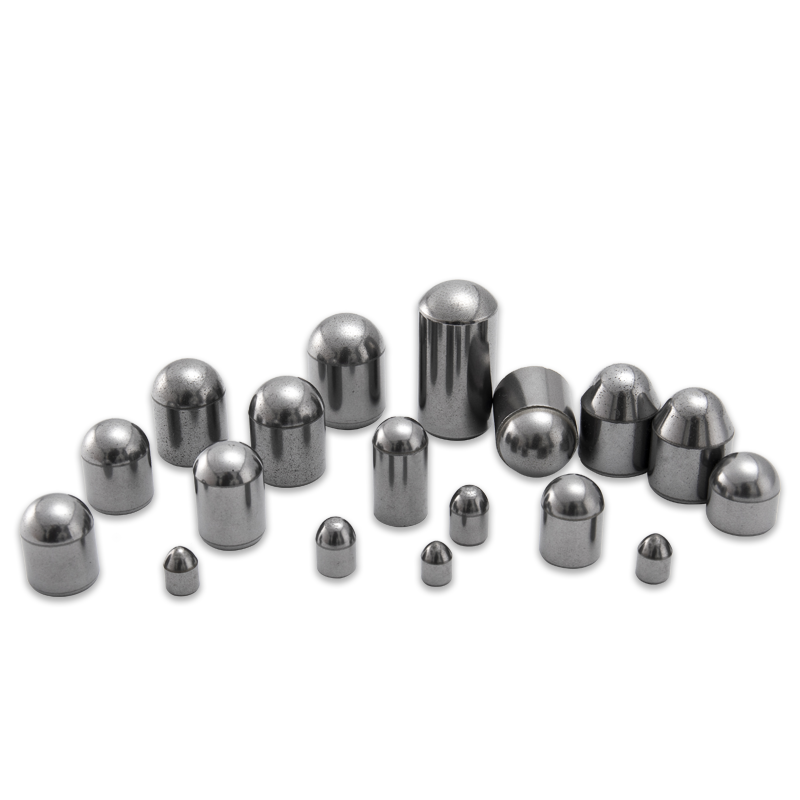
Button bits carry spherical or ballistic inserts. Spherical buttons tend to suit hard, abrasive formations where wear life matters. Ballistic buttons can penetrate more aggressively in softer or less abrasive ground, but they may not hold their shape as long in very hard rock. Chisel and cross bits present a narrower cutting edge, which can be useful in softer or fractured formations where a button bit might struggle to keep the hole clean.
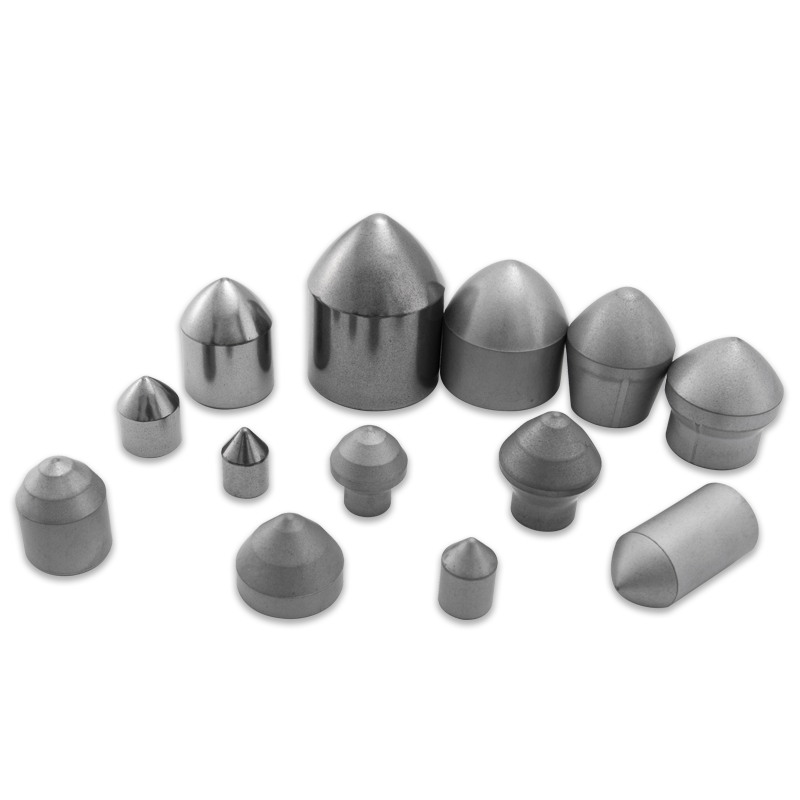
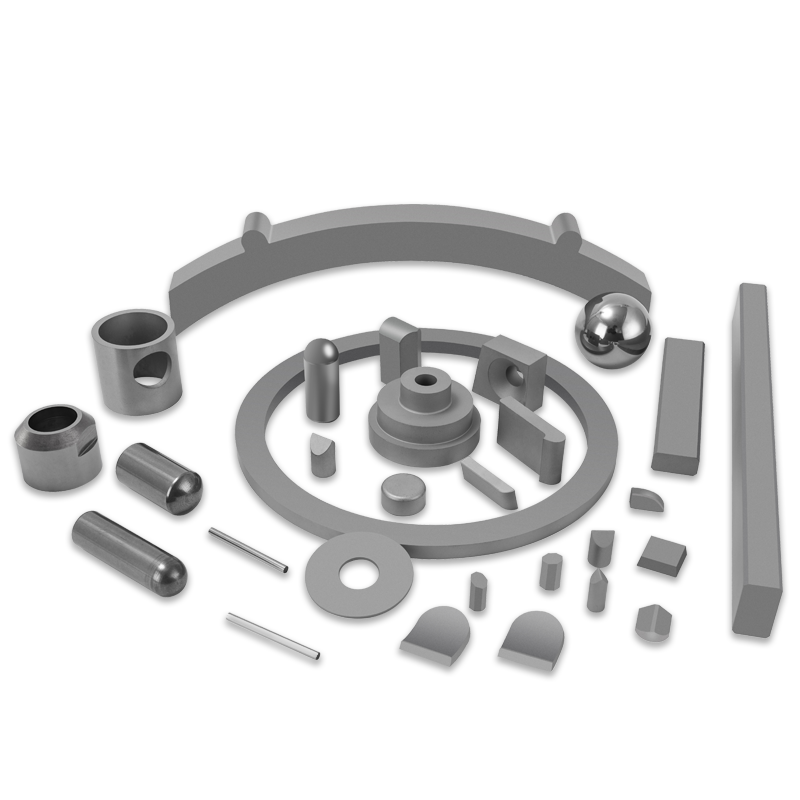
 Tungsten Carbide Rock Drilling Tool SeriesA series of carbide grades and tool types for impact- and wear-heavy rock drilling, with specifications and applications to match different bits and formations.View Product →
Retrac bits use a body profile that helps the bit follow the hole when backing out in broken ground. Drop-center bits leave a small core in the center of the hole, which can improve straightness and stability in some conditions. Reaming and pilot-adapter tools are used where a hole must be opened up or guided, rather than simply driven forward.
Matching the Tool to the Ground
There is no universal bit for every formation. The table below is a practical starting point, not a final specification. Rock compressive strength, abrasiveness, fracture pattern, hole diameter, and the available percussion energy will all shift the choice.
| Tool style | Ground conditions | Why it is used | Watch-outs |
|---|---|---|---|
| Spherical button bit | Hard, abrasive rock such as granite or basalt | Good wear resistance and stable load distribution | May drill slower in soft, fractured ground |
| Ballistic button bit | Medium-hard, less abrasive formations | More aggressive penetration and good chip removal | Can wear quickly in highly abrasive rock |
| Chisel or cross bit | Softer, bedded, or fractured rock | Narrow cutting edge helps start and steer the hole | Less suited to very hard, uniform rock |
| Retrac bit | Broken ground and deeper holes | Body profile helps the bit return through unstable ground | Requires careful matching to hole condition |
| Drop-center bit | Ground where hole straightness matters | Leaves a small core to help stabilize the bit | Flushing and feed force must be set correctly |
| Reaming or pilot bit | Large-diameter or guided drilling | Opens or follows an existing hole | Needs a compatible pilot and machine setup |
For a more detailed selection checklist, our practical guide to choosing tungsten carbide rock drilling tools walks through formation assessment and bit configuration in more depth.
Grade, Braze, and Body: The Details That Decide Tool Life
Carbide grade and insert shape
A drill bit can fail even when the carbide itself is hard enough. If the grade is too brittle for the impact energy, inserts may chip. If it is too soft for the rock, the bit may wear out of gauge before the body is spent. Insert protrusion, button spacing, and face angle affect how the load enters the rock and how the bit clears cuttings.
Braze and steel body
Braze quality is often overlooked until a button comes loose. A sound braze needs clean surfaces, controlled heat, and a join that does not leave residual stress around the insert. The steel body must also resist fatigue and thread wear. In top-hammer work, the shank and thread are part of the load path, not just a connection.
Flushing and hole cleaning
Rock drilling tools cut rock, but they also have to move cuttings out of the hole. If flushing air or water is insufficient, cuttings regrind, heat rises, and wear accelerates. Check flushing holes for blockages and make sure the bit design matches the available air volume or water pressure.
When the Ground Calls for Something Bigger: TBM Inserts and Mining Picks
Not every rock drilling job happens at the end of a hand-held or top-hammer string. Tunnel boring machines use carbide inserts on the cutter head, where they meet rock under very high rolling and impact loads. The insert shape, grade, and support in the cutter body have to be matched to the machine, the rock mass, and the tunnel diameter.
Tungsten Carbide Inserts for Tunnel Boring MachinesCarbide inserts for TBM and rotary excavation cutter heads, with grades for medium-hard to hard rock and complex geological conditions.View Product →
In coal mining and roadheader work, round shank picks are the familiar wear part. They cut coal, shale, and occasionally harder bands, so the carbide tip needs a balance of sharpness and impact resistance. The same material logic applies, but the loading is different from a drill bit: the pick is dragged or rotated through the face rather than driven by percussion.
Field Notes: Getting More Life From the Tool
Most premature failures we see are not mysterious. They come from a mismatch that was visible before the tool went underground. A few simple habits make a difference:
- Inspect the bit face, gauge, thread, and flushing holes at the start of each shift.
- Keep button bits within gauge; regrind worn buttons when the flat area becomes too large.
- Watch for loose or cracked inserts and stop using a bit with a damaged braze.
- Match feed force and rotation to the bit and rock; too much force can overload the inserts.
- Keep the hole clean. Poor flushing wears the bit body and the carbide at the same time.
It also helps to record where a bit failed, not just that it failed. A broken button, a worn gauge, a pulled thread, and a cracked body point to different causes. That record is more useful than a general impression of “poor bit life.”
A useful discussion about tungsten carbide rock drilling tools starts with the job, not the catalogue. Tell the supplier the rock type and approximate compressive strength, whether the ground is abrasive or fractured, the hole diameter and depth, the drilling method, the machine model, and the flushing medium. If you have photos of failed tools, include them. A worn gauge and a broken insert tell different stories.
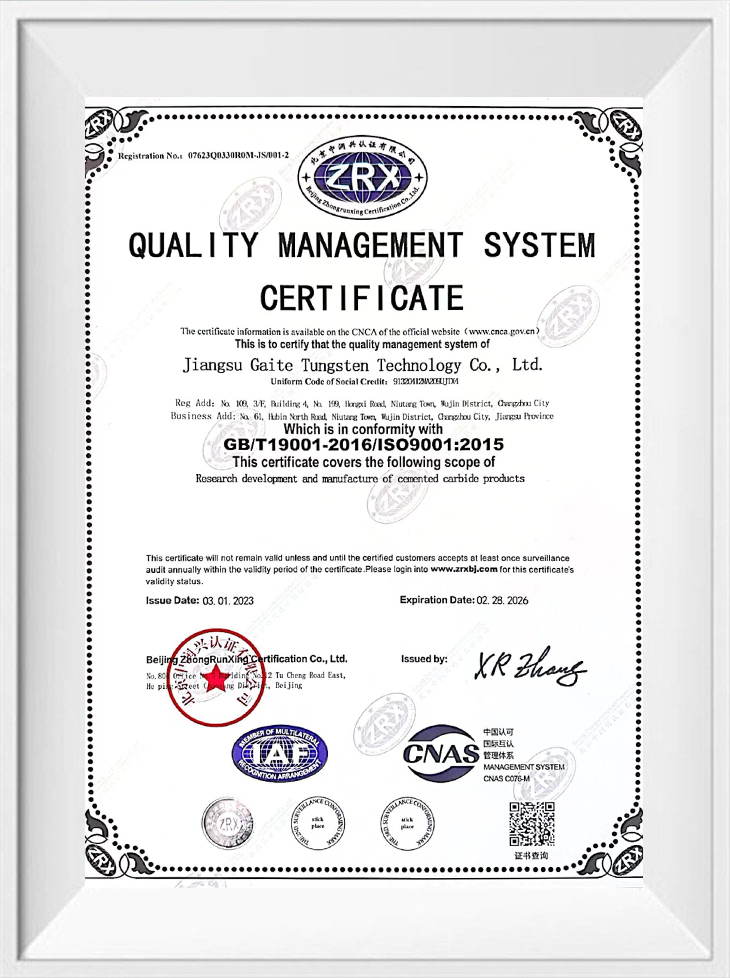
At Gaite, we produce carbide components and tools from our base in Changzhou, with ISO 9001 and ISO 14001 management systems, low-pressure sintering, presses, and precision grinding equipment. We can work from standard designs or review a drawing for a custom part. The aim is not to sell the hardest carbide available; it is to match the grade, geometry, and support to the rock you actually drill.
A Final Word
Tungsten carbide rock drilling tools reward a joined-up view. The rock sets the demand, the machine sets the energy, and the bit has to carry both without losing its shape. When grade, insert geometry, braze, body, and flushing are considered together, the tool lasts longer and the hole goes down straighter. That is the kind of practical result we try to build into every conversation with a drilling team.
Our Products //
Related Products
If you are interested in our products, please consult us
