

 English
 русский
Tungsten Carbide Stamping Dies: Material Advantages, Design Considerations, and Maximizing Tool Life
Industry News-Content
- 1 Why Tungsten Carbide Is the Premier Material for Stamping Dies
- 2 Key Material Properties of Tungsten Carbide for Die Applications
- 3 Tungsten Carbide Stamping Die Grade Selection Guide
- 4 Types of Tungsten Carbide Stamping Dies and Their Construction
- 5 Manufacturing and Grinding of Tungsten Carbide Stamping Dies
- 6 Optimizing Clearance, Lubrication, and Press Setup for Carbide Stamping Dies
- 7 Maintenance, Resharpening, and Reconditioning of Carbide Stamping Dies
- 8 Tungsten Carbide vs. Tool Steel Stamping Dies: A Direct Comparison
Why Tungsten Carbide Is the Premier Material for Stamping Dies
Tungsten carbide stamping dies have become the industry benchmark for high-volume metal forming, blanking, piercing, and progressive die operations where tool longevity, dimensional consistency, and resistance to abrasive wear are non-negotiable requirements. The material's exceptional hardness — typically ranging from 85 to 93 HRA (Rockwell A) depending on grade and binder content — is the primary reason carbide dies outlast conventional tool steel alternatives by factors of 10 to 50 times in demanding production environments. This extraordinary hardness derives from the crystal structure of tungsten carbide (WC) particles, which rank second only to diamond on the Mohs scale, bound together in a metallic cobalt or nickel matrix through a liquid-phase sintering process.
Beyond raw hardness, tungsten carbide stamping dies offer a combination of properties that no single alternative material can replicate. The compressive strength of cemented carbide exceeds 4,000 MPa — roughly four times that of D2 tool steel — enabling carbide dies to withstand the extreme contact stresses generated during high-speed stamping of hard materials such as stainless steel, electrical steel laminations, copper alloys, and hardened spring steel strip. The material's low coefficient of thermal expansion and high thermal conductivity maintain dimensional stability under the cyclic heating generated in continuous high-speed press operations, preventing the thermal fatigue cracking that progressively degrades tool steel dies at elevated stroke rates.
Key Material Properties of Tungsten Carbide for Die Applications
The performance of a tungsten carbide stamping die in production is directly determined by the specific grade of cemented carbide selected. Carbide grades are engineered by varying the tungsten carbide grain size, the type and percentage of metallic binder, and the addition of secondary carbides such as titanium carbide (TiC), tantalum carbide (TaC), or chromium carbide (Cr₃C₂). Each of these variables creates a different balance between hardness, toughness, wear resistance, and corrosion resistance.
Hardness and Wear Resistance
Hardness is the property most directly associated with wear resistance in tungsten carbide die applications. As cobalt binder content decreases from 25 wt% toward 3 wt%, hardness increases progressively from approximately 85 HRA to 93 HRA. Fine and ultrafine WC grain sizes — below 1 micron — further elevate hardness by reducing the mean free path between hard carbide particles, which increases resistance to micro-abrasion at cutting edges and forming radii. For stamping dies operating on highly abrasive materials such as silicon steel, cold-rolled stainless steel, or powder metal compacts, ultrafine-grain grades with 6–10 wt% cobalt deliver the optimal combination of high hardness and adequate fracture toughness to resist chipping during press loading.
Fracture Toughness and Impact Resistance
Fracture toughness (K₁c) measures a material's resistance to crack propagation under impact or shock loading — the property that determines whether a die will chip, crack, or catastrophically fracture when subjected to sudden overloads, press misfeeds, or double-hit events. Tungsten carbide's toughness increases with cobalt content, ranging from approximately 8 MPa·m½ at 6 wt% Co to over 15 MPa·m½ at 20–25 wt% Co. For stamping dies that experience significant impact loading — such as heavy blanking dies operating on thick material, or progressive dies with complex punch geometries that generate asymmetric cutting forces — selecting a grade with higher cobalt content is essential to prevent catastrophic fracture, even at the cost of some wear resistance. The correct grade selection balances the competing demands of hardness and toughness based on the specific stress profile of the application.
Compressive Strength and Elastic Modulus
The elastic modulus of tungsten carbide — approximately 550–650 GPa depending on grade — is roughly three times higher than that of tool steel. This extreme stiffness means carbide stamping dies deflect far less under press load than equivalent tool steel tooling, which directly translates to tighter part tolerances, more consistent feature-to-feature dimensions in progressive die work, and reduced springback variation in forming operations. The high compressive strength prevents die surface deformation and indentation under repeated high-pressure contact, which is the primary mechanism of dimensional drift in tool steel dies operating on hard strip materials.
Tungsten Carbide Stamping Die Grade Selection Guide
Selecting the correct carbide grade for a stamping die application requires matching material properties to the specific combination of workpiece material, press speed, die geometry, and expected production volume. The following table summarizes the most commonly used carbide grade categories for stamping die applications and their optimal use cases.
| Grade Category | Co Binder (%) | Hardness (HRA) | Grain Size | Best Application |
| High Hardness / Low Co | 3–6% | 91–93 | Ultrafine (<0.5 µm) | Fine blanking, precision piercing of thin hard strip |
| General Purpose | 8–12% | 88–91 | Fine (0.5–1.5 µm) | Progressive stamping dies, electrical lamination punching |
| Medium Toughness | 13–16% | 86–88 | Medium (1.5–3 µm) | Blanking of medium-gauge stainless steel and copper alloys |
| High Toughness | 18–25% | 83–86 | Coarse (3–6 µm) | Heavy-gauge blanking, forming dies with high impact loading |
| Ni-Bonded / Corrosion Resistant | 6–12% Ni | 87–90 | Fine–Medium | Stamping of corrosive materials, medical device components |
Nickel-bonded carbide grades deserve special mention for applications involving stamping of corrosive strip materials, or where die components will be exposed to aggressive lubricants and coolants. Cobalt binder is susceptible to preferential corrosive attack in acidic environments, which degrades the binder phase and causes accelerated surface roughening. Nickel-bonded tungsten carbide stamping dies offer equivalent hardness and toughness to cobalt grades while providing significantly better corrosion resistance in these environments, making them the preferred choice for medical device stamping and electronics connector manufacturing where process cleanliness standards are stringent.
Types of Tungsten Carbide Stamping Dies and Their Construction
Tungsten carbide is applied in stamping die construction in several distinct forms, each suited to different production scales, part geometries, and economic considerations. Understanding the construction options available allows toolmakers and manufacturing engineers to optimize both initial tooling cost and total cost per part over the production run.
Solid Carbide Stamping Dies
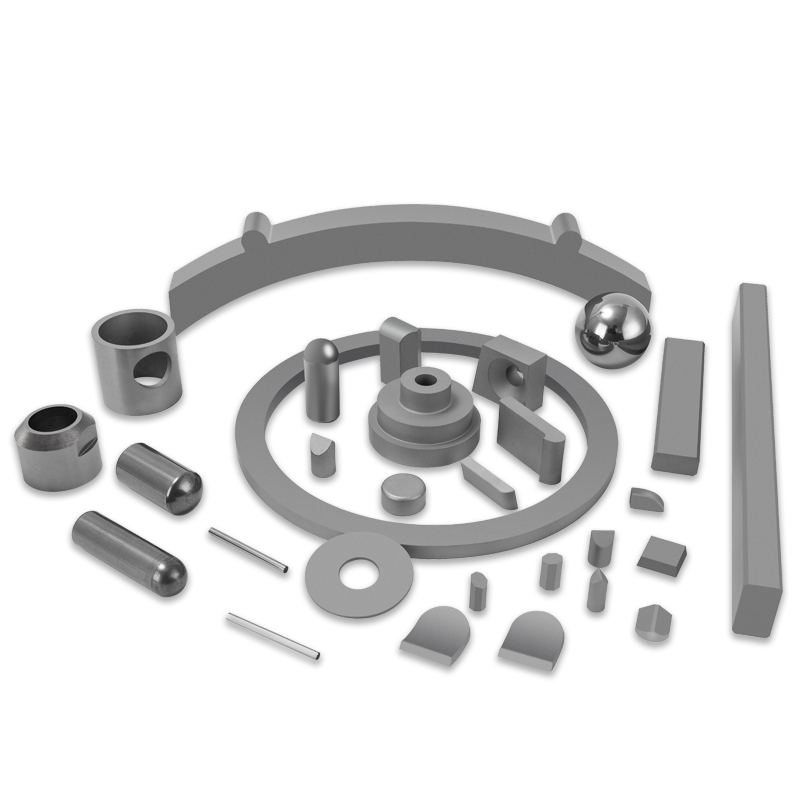
Solid tungsten carbide stamping dies are machined entirely from a single piece of sintered carbide. This construction is standard for small-diameter punches below approximately 25 mm, small blanking dies, piercing inserts, and precision form punches where the compact geometry allows the carbide to be fully supported against bending and tensile stresses. Solid carbide punches for connector terminal stamping, lead frame manufacturing, and electrical contact production routinely achieve service lives exceeding 50 to 100 million strokes on thin copper and brass strip materials. The primary limitation of solid carbide construction is brittleness under bending loads — solid carbide punches with high aspect ratios (length-to-diameter ratios above 5:1) are susceptible to lateral buckling failure and require precision guide bushings and minimal punch-to-guide clearance to remain within safe stress limits.
Carbide-Inserted and Shrink-Fit Die Construction
For larger stamping die components — blanking plates, die buttons, forming inserts, and draw rings — solid carbide construction becomes prohibitively expensive and impractical to manufacture and handle. The industry-standard solution is to press-fit or shrink-fit a carbide insert into a steel retainer that provides structural support, shock absorption, and the mechanical interface for die set mounting. The interference fit between the carbide insert and the steel holder places the carbide in residual compressive stress, dramatically improving its resistance to tensile cracking during stamping. Typical interference values for carbide die button installations range from 0.001 to 0.003 inches per inch of carbide outside diameter. Improper interference fit — either insufficient (allowing fretting and migration) or excessive (causing hoop stress cracking during assembly) — is one of the most common causes of premature carbide die insert failure in production.
Segmented Carbide Progressive Dies
Complex progressive stamping dies that perform multiple blanking, piercing, bending, and forming operations in a single strip progression are often constructed with segmented carbide inserts mounted in precision steel die shoes. Each station in the progressive die incorporates dedicated carbide punch and die insert pairs optimized for that station's specific operation and workpiece material contact conditions. This segmented approach allows individual worn or damaged carbide stations to be replaced without scrapping the entire die assembly, and enables different carbide grades to be used at different stations based on each station's specific stress profile. High-volume progressive die tooling for electrical motor lamination stamping, automotive connector terminals, and IC lead frame production represent the most sophisticated examples of segmented carbide progressive die construction, with some tooling achieving cumulative production runs exceeding one billion parts before major rebuild.
Manufacturing and Grinding of Tungsten Carbide Stamping Dies
The manufacturing of tungsten carbide stamping dies requires specialized equipment, tooling, and process knowledge that differs fundamentally from conventional tool steel die manufacturing. The extreme hardness of carbide makes conventional machining impossible — all material removal must be performed using diamond abrasives or electrical discharge machining (EDM), and process parameter selection directly determines final die performance.
Diamond Grinding for Carbide Die Profiles
Diamond wheel grinding is the primary manufacturing method for producing the flat surfaces, cylindrical profiles, and angular features of tungsten carbide stamping die components. Resin-bonded, vitrified, and metal-bonded diamond wheels are selected based on the carbide grade being ground and the surface finish required. The critical process parameters — wheel speed, workpiece feed rate, depth of cut per pass, and coolant flow — must be carefully controlled to avoid thermal damage to the carbide surface that manifests as micro-cracking, residual tensile stress, or surface phase transformation. Surface grinding of carbide die plates requires flood coolant application, sharp dressing of the diamond wheel, and light finishing passes below 0.005 mm depth of cut to achieve the surface finish quality (Ra below 0.2 µm) and flatness tolerance required for precision blanking die clearances.
Wire EDM for Complex Carbide Die Geometries
Wire electrical discharge machining (wire EDM) has become the dominant method for cutting complex two-dimensional profiles in tungsten carbide die plates, including irregular blanking outlines, progressive die apertures, and precision form die cavities. Wire EDM removes material by controlled spark erosion using a continuously fed brass or zinc-coated wire electrode, making it entirely independent of workpiece hardness. Modern five-axis wire EDM systems can cut carbide die components to dimensional tolerances within ±0.002 mm and achieve surface finishes below Ra 0.3 µm after fine-finishing cut sequences. A critical consideration in wire EDM of carbide is the recast layer — a thin zone of resolidified material approximately 2–10 µm deep that contains tensile residual stresses and micro-cracks. Multiple skim cuts with decreasing energy settings progressively remove the recast layer from previous cuts, and final EDM surface quality must be verified to ensure no residual recast remains on cutting edge surfaces that would serve as crack initiation sites in production.
Lapping and Polishing for Critical Die Surfaces
After grinding and EDM operations, the cutting edges, forming radii, and clearance surfaces of tungsten carbide stamping dies are typically finished by diamond lapping or polishing to remove any residual machining damage and achieve the final surface quality specification. Hand lapping with diamond paste on hardened steel or cast iron lap plates — using progressively finer grades from 15 µm down to 1 µm or below — removes surface irregularities and establishes the consistent edge geometry critical to cut quality and die life. For high-precision fine blanking carbide dies and coin dies, final surface finishes below Ra 0.05 µm on forming surfaces are required to achieve the part surface quality specifications and minimize material adhesion during stamping.
Optimizing Clearance, Lubrication, and Press Setup for Carbide Stamping Dies
Even the highest-quality tungsten carbide stamping die will fail prematurely if run with incorrect punch-to-die clearance, inadequate lubrication, or improper press setup. These operational parameters have an outsized influence on die life, part quality, and the risk of catastrophic carbide fracture during production.
Punch-to-Die Clearance for Carbide Tooling
Optimal punch-to-die clearance for tungsten carbide blanking and piercing dies is generally tighter than equivalent tool steel tooling — typically 3 to 8 percent of material thickness per side for most metals, compared to 8 to 12 percent for tool steel dies. Tighter clearances are enabled by carbide's superior wear resistance and dimensional stability, and produce cleaner cut surfaces with less rollover, burnish depth, and fracture zone angle. However, clearance that is too tight concentrates cutting forces on the carbide cutting edges, accelerating edge chipping and increasing the risk of punch or die plate cracking. Clearance optimization should be validated by examining cut edge quality using a calibrated optical comparator or scanning electron microscope to confirm the desired fracture zone angle and burr height before committing to production quantities.
Lubrication Requirements
Proper lubrication is critical to maximizing carbide stamping die service life by reducing friction at the punch-to-material interface, preventing material pickup (galling) on die surfaces, and controlling die temperature during high-speed operation. For most carbide progressive stamping operations on steel and stainless steel strip, a light-viscosity sulfurized or chlorinated extreme-pressure stamping oil applied via roller coater or spray system at a controlled film weight of 0.5 to 2.0 g/m² provides adequate lubrication. On copper and brass strip, non-chlorinated formulations are required to prevent corrosive staining. Dry film lubricants — including molybdenum disulfide and PTFE coatings applied to the strip — are used in applications where oil contamination of stamped parts is unacceptable, such as electrical contact and medical device manufacturing.
Press Requirements for Carbide Die Protection
Tungsten carbide's brittleness under tensile and bending stress means that carbide stamping dies are highly sensitive to press misalignment, slide parallelism errors, and off-center loading that would be tolerated by tool steel tooling. Running carbide dies in a worn or misaligned press is one of the fastest ways to cause premature die failure. The press used for carbide tooling should exhibit slide-to-bed parallelism within 0.010 mm over the full die area, and hydraulic overload protection set at 110–120 percent of calculated cutting force to arrest press travel in the event of a misfeed or double-hit before catastrophic die damage occurs. Quick-disconnect die protection sensors — monitoring strip feed, part ejection, and die protection pin deflection — are standard equipment on progressive carbide die lines and pay for themselves rapidly through prevention of a single catastrophic carbide fracture event.
Maintenance, Resharpening, and Reconditioning of Carbide Stamping Dies
One of the significant economic advantages of tungsten carbide stamping dies over tool steel is the ability to recondition worn tooling by precision regrinding of cutting faces, restoring sharp cutting edges and correct clearance geometry. A well-maintained carbide die can typically be resharpened 20 to 50 times before the accumulated stock removal reduces the die to below minimum height specifications, delivering a total service life many times longer than the initial tool life between grinds.
- Monitoring Wear Indicators: Establish production monitoring protocols that track burr height on stamped parts, cut edge rollover depth, and press tonnage trend data as indicators of progressive die wear. Initiating regrind at the first sign of burr development — rather than running until part quality is out of specification — minimizes the stock removal required per regrind cycle and maximizes the total number of regrind cycles available before the die reaches scrap height.
- Surface Grinding for Regrind: Carbide die face regrinding is performed on a precision surface grinder using a resin-bonded diamond cup wheel or segmented diamond face wheel. The minimum stock removal per regrind should be sufficient to break through the complete wear-affected zone — typically 0.05 to 0.15 mm per face — to expose fresh, undamaged carbide with sharp cutting edges.
- Edge Honing After Regrind: Freshly ground carbide cutting edges contain micro-chipping and grinding burrs that reduce initial tool life if not addressed before returning the die to production. A light controlled edge hone using a fine diamond or boron nitride stone — removing only 0.005 to 0.020 mm of edge material at a consistent angle — strengthens the cutting edge geometry and significantly improves first-hit tool life after regrind.
- Inspection After Each Regrind: Following each regrind cycle, inspect all carbide components under magnification (at minimum 10× loupe, ideally toolmaker's microscope) for micro-cracks, edge chipping, and surface irregularities before reinstalling in the die set. Cracks in carbide die components will propagate rapidly under production loading and cause catastrophic failure — identifying them at inspection prevents downstream press damage and unplanned downtime.
- Recoating for Extended Life: Physical vapor deposition (PVD) coatings — particularly TiN, TiCN, TiAlN, and DLC (diamond-like carbon) — applied to carbide stamping punch surfaces after grinding can extend intervals between regrinds by 2 to 4 times on abrasive workpiece materials. DLC coatings are particularly effective on copper and aluminum stamping applications where material adhesion to the die surface is a primary wear mechanism.
Tungsten Carbide vs. Tool Steel Stamping Dies: A Direct Comparison
The decision between tungsten carbide and tool steel for a stamping die application involves balancing initial tooling investment against total cost of ownership over the production run. The following comparison provides a practical framework for this decision across the most relevant performance and economic dimensions.
| Parameter | Tungsten Carbide Die | Tool Steel Die (D2 / M2) |
| Hardness | 85–93 HRA (≈1400–1800 HV) | 58–65 HRC (≈650–830 HV) |
| Typical Tool Life | 5–50 million strokes (application dependent) | 100,000–1 million strokes |
| Initial Tooling Cost | 3–8× higher than tool steel | Baseline |
| Cost per Part (high volume) | Significantly lower | Higher due to frequent replacement |
| Dimensional Stability | Excellent (high modulus) | Good (lower modulus) |
| Impact / Shock Resistance | Moderate (brittle — grade dependent) | Good–Excellent |
| Machinability / Repairability | Difficult (diamond / EDM only) | Good (conventional machining) |
| Best For | High-volume, abrasive materials, tight tolerances | Prototypes, low volume, complex 3D forming |
The economic crossover point — the production volume above which carbide's lower cost per part offsets its higher initial tooling investment — typically falls between 500,000 and 2 million parts depending on the complexity of the die, the workpiece material hardness, and the regrind interval achievable with each material. For any stamping program anticipated to exceed 2 million parts, the total cost of ownership analysis almost universally favors tungsten carbide stamping die construction over tool steel alternatives.
Our Products //
Related Products

If you are interested in our products, please consult us
