

 English
 русский
How to Customize Tungsten Carbide Parts That Actually Last
Industry News-Content
- 1 What Does It Actually Mean to Customize Tungsten Carbide?
- 2 Why So Many Businesses Choose to Customize Tungsten Carbide Instead of Buying Standard Parts
- 3 Key Factors That Shape Every Custom Tungsten Carbide Order
- 4 Common Types of Custom Tungsten Carbide Products
- 5 How Custom Tungsten Carbide Parts Are Actually Made
- 6 Practical Tips for Getting the Best Results When You Customize Tungsten Carbide
- 7 Mistakes to Avoid When Customizing Tungsten Carbide
What Does It Actually Mean to Customize Tungsten Carbide?
When people talk about custom tungsten carbide, they usually mean taking this incredibly hard, wear-resistant material and shaping it into a part that fits one very specific job — not a generic, off-the-shelf size. Tungsten carbide on its own is basically a mix of tungsten carbide powder and a metal binder, most often cobalt, pressed and sintered into a solid block. Customization is the process of controlling every variable in that process — the shape, the grain size, the hardness, the binder ratio, even the surface finish — so the final part performs exactly the way your application demands. Whether you're making cutting tools, wear-resistant dies, or precision components for a machine that runs 24/7, customizing tungsten carbide is what turns a raw hard material into a part that actually solves your problem.
This isn't a one-size-fits-all material. A tungsten carbide insert used to cut soft aluminum needs a very different grain structure and cobalt content than a carbide punch used to stamp thick steel sheets thousands of times a day. That's exactly why manufacturers offer customization services — so engineers and buyers can specify exactly what they need instead of settling for a generic part that might fail early or underperform.
Why So Many Businesses Choose to Customize Tungsten Carbide Instead of Buying Standard Parts
Standard tungsten carbide blanks are fine for general use, but most industrial applications aren't general — they're specific. A company running high-speed CNC machining needs carbide tooling with a particular edge geometry and coating. A mining operation needs carbide wear plates shaped to fit an odd-angled chute. A jewelry brand wants tungsten carbide rings in a custom width, finish, and inlay pattern. In every one of these cases, a standard part either doesn't fit or doesn't last as long as it should.
Customizing tungsten carbide lets a business match the part to the exact stress, temperature, and wear conditions it will face. This usually means longer tool life, fewer replacements, less downtime, and in many cases, lower cost per unit over time even though the upfront design work takes longer. It also opens the door to solving problems that generic parts simply can't — like an oddly shaped die, a part that needs to resist both abrasion and corrosion, or a component that must be non-magnetic.
Key Factors That Shape Every Custom Tungsten Carbide Order
Before you send a drawing to a manufacturer, it helps to understand the variables that actually control how your custom tungsten carbide part will perform. Getting these right at the design stage saves time, money, and a lot of back-and-forth revisions later.
Cobalt Content
Cobalt acts as the binder holding the tungsten carbide grains together. A lower cobalt percentage (around 6%) produces a harder, more wear-resistant part that's better for cutting and abrasion-heavy applications. A higher cobalt percentage (10% or more) produces a tougher part that resists chipping and cracking under impact, which is better for stamping or heavy-duty punching.
Grain Size
Fine-grain carbide offers a sharper edge and better wear resistance, making it popular for precision cutting tools. Coarse-grain carbide handles heavier impact and shock loads better, which suits mining and heavy machinery parts. Ultra-fine grain grades are increasingly used where both hardness and toughness are needed at the same time.
Shape and Tolerance
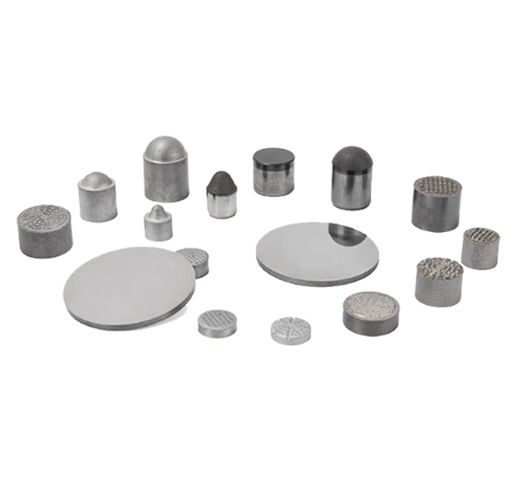
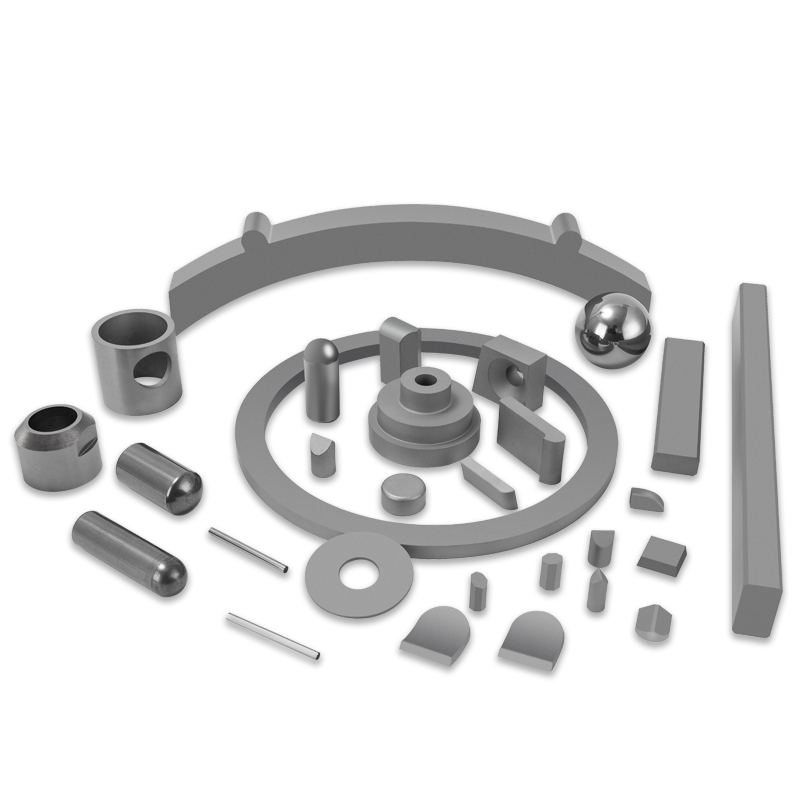
Custom tungsten carbide can be produced as rods, blocks, rings, plates, or fully finished parts machined to tight tolerances. The tighter the tolerance, the more precision grinding is required after sintering, which affects both lead time and cost.
Surface Treatment
Coatings like TiN, TiAlN, or DLC can be added to further increase wear resistance, reduce friction, or change the surface color — this matters both for industrial tools and for decorative products like tungsten carbide rings.
Common Types of Custom Tungsten Carbide Products
Custom tungsten carbide shows up in far more industries than people expect. Here's a quick look at some of the most common product categories and what they're typically customized for.
| Product Type | Typical Customization | Common Industry |
| Cutting Inserts | Edge geometry, coating, grain size | Machining and metalworking |
| Wear Plates | Shape, thickness, cobalt ratio | Mining and heavy equipment |
| Dies and Punches | Custom profile, toughness grade | Metal stamping and forming |
| Rings and Jewelry | Width, finish, inlay, engraving | Fashion and accessories |
| Nozzles and Seals | Bore diameter, surface finish | Oil, gas, and fluid handling |
How Custom Tungsten Carbide Parts Are Actually Made
Understanding the production process helps you communicate better with your manufacturer and set realistic expectations for lead time and cost. Most custom tungsten carbide parts go through the following stages.
- Powder blending — tungsten carbide powder is mixed with cobalt binder in the ratio specified for the part's hardness and toughness needs.
- Pressing — the powder mix is pressed into a rough shape close to the final part, called a "green" compact.
- Sintering — the pressed shape is heated in a furnace to extremely high temperatures, fusing the particles into a dense, solid carbide part.
- Precision grinding — the sintered part is ground down to the exact dimensions and tolerances required by the design.
- Surface finishing — polishing, coating, or engraving is applied depending on the part's final use.
- Quality inspection — hardness testing, dimensional checks, and sometimes microstructure analysis confirm the part meets spec before shipping.
Practical Tips for Getting the Best Results When You Customize Tungsten Carbide
A little preparation before you contact a manufacturer can save weeks of revisions. Keep these points in mind when you're planning a custom tungsten carbide order.
- Describe the working environment, not just the shape — temperature, impact level, and chemical exposure all affect which grade is right for you.
- Ask for a sample or small test batch before committing to a large production run, especially for a new application.
- Get tolerance requirements in writing early, since tighter tolerances usually mean longer lead times and higher cost.
- Compare cobalt grades side by side if you're unsure between hardness and toughness — many suppliers offer comparison charts.
- Confirm whether coating is included in the quoted price, since it's often billed separately.
Mistakes to Avoid When Customizing Tungsten Carbide
Even experienced buyers run into avoidable problems when ordering custom tungsten carbide parts. One of the most common mistakes is choosing a grade based purely on hardness numbers without considering toughness — a part that's extremely hard but too brittle for its application can chip or crack early, which defeats the purpose of customizing it in the first place.
Another frequent issue is underestimating lead time. Because sintering and grinding are precise, time-intensive steps, rushing a custom order can lead to lower-quality results or inflated costs. It also helps to avoid over-specifying tolerances tighter than the application actually requires, since unnecessary precision adds cost without adding real-world benefit. Finally, skipping a prototype or sample run on a new design is a common shortcut that often costs more in the long run if the first full batch doesn't perform as expected.
Customizing tungsten carbide is ultimately about matching material science to real-world demands. When the grade, shape, and finish are chosen carefully, a custom tungsten carbide part can outperform a generic one by a wide margin — lasting longer, resisting wear better, and ultimately saving money over its working life.
Our Products //
Related Products
If you are interested in our products, please consult us
