

 English
 русский
The Practical Guide to Tungsten Carbide Stamping Dies: Grades, Design, and How to Make Them Last
Industry News-Content
- 1 What Is a Tungsten Carbide Stamping Die and Why Does It Matter?
- 2 Tungsten Carbide vs. Tool Steel Dies: Understanding the Real Difference
- 3 Tungsten Carbide Grades Used in Stamping Dies: How to Choose the Right One
- 4 Key Components of a Tungsten Carbide Stamping Die Assembly
- 5 Manufacturing Methods: How Tungsten Carbide Stamping Dies Are Made
- 6 Maintenance and Regrinding: Extending Tungsten Carbide Die Life
- 7 What to Look for When Sourcing a Tungsten Carbide Stamping Die Supplier
What Is a Tungsten Carbide Stamping Die and Why Does It Matter?
A tungsten carbide stamping die is a precision tooling component used in metal stamping operations to cut, form, pierce, or shape sheet metal with high repeatability and extreme accuracy. Unlike conventional tool steel dies, tungsten carbide dies are made from a composite material — primarily tungsten carbide (WC) particles sintered together with a metallic binder, most commonly cobalt (Co). The result is a material that combines exceptional hardness (typically 85–93 HRA on the Rockwell scale) with enough toughness to withstand the repeated impact loads of high-speed stamping without chipping or deforming.
In high-volume production environments — automotive components, electronics terminals, medical device parts, electrical connectors, and precision fasteners — tungsten carbide stamping dies are the standard choice for tooling that needs to deliver millions of consistent hits before requiring replacement. The initial tooling cost is higher than tool steel, but the dramatically extended service life and reduced downtime make carbide dies the economically superior choice at scale. This guide covers everything from grade selection and die design considerations to maintenance practices and what to look for when sourcing carbide stamping dies.
Tungsten Carbide vs. Tool Steel Dies: Understanding the Real Difference
The decision between tungsten carbide and tool steel for stamping die construction is one of the most consequential choices in press tooling. Each material has a distinct performance profile, and the right choice depends on production volume, material being stamped, and acceptable downtime for regrinding or replacement.
| Property | Tungsten Carbide Die | Tool Steel Die (D2 / M2) |
| Hardness | 85–93 HRA | 58–65 HRC |
| Wear resistance | Excellent — 5–20× longer life | Good for moderate volumes |
| Toughness | Moderate — grade-dependent | Higher — more impact-forgiving |
| Compressive strength | Up to 6,000 MPa | 1,500–2,500 MPa |
| Upfront tooling cost | Higher (3–5× tool steel) | Lower |
| Cost per part over lifetime | Lower at high volumes | Higher due to frequent replacement |
| Best application | High-volume, abrasive, or hard materials | Prototypes, low-volume, complex geometry |
| Machinability | Requires EDM and diamond grinding | Conventional milling and grinding |
For production runs exceeding 500,000 parts, tungsten carbide stamping dies almost always deliver a lower total cost of ownership despite the higher entry price. Below that threshold, the calculation depends heavily on the material being stamped and the acceptable regrind frequency for tool steel alternatives.
Tungsten Carbide Grades Used in Stamping Dies: How to Choose the Right One
Tungsten carbide is not a single material — it's a family of composites with varying ratios of WC grain size and cobalt binder content. These variables directly control the balance between hardness and toughness, and selecting the wrong grade for a stamping application leads to premature failure through either excessive wear or chipping.
Cobalt Content and Its Effect on Performance
Cobalt is the metallic binder that holds tungsten carbide grains together. Low cobalt content (3–6% Co) produces a harder, more wear-resistant die material — ideal for stamping thin, soft materials at very high speeds where abrasive wear is the primary failure mode. Higher cobalt content (8–15% Co) trades some hardness for significantly improved toughness and crack resistance, making it the better choice for stamping thicker stock, harder alloys like stainless steel or high-strength steel, or applications involving shock-loading from part ejection or misfeeds. Most stamping die applications fall into the 6–10% Co range, which represents the practical sweet spot between wear resistance and impact toughness.
Grain Size and Its Role in Edge Sharpness
WC grain size — ranging from submicron (under 0.5μm) to coarse (over 3μm) — affects both the achievable edge sharpness and the surface finish of the stamped part. Fine and ultrafine grain carbides support sharper cutting edges with tighter dimensional tolerances, making them the preferred choice for precision blanking, fine piercing, and micro-stamping of thin foil materials in electronics and medical device manufacturing. Coarser grain grades are tougher and better suited to heavy blanking, deep drawing inserts, and applications where edge sharpness is less critical than impact resistance.
Common Grade Recommendations by Application
- Punching thin copper or aluminum strip (electronics terminals): Fine grain, 6% Co — maximum wear resistance for abrasive non-ferrous materials at high SPM rates.
- Blanking mild steel up to 3mm: Medium grain, 8–10% Co — balanced hardness and toughness for general-purpose steel stamping.
- Stamping stainless steel or high-strength steel: Medium-coarse grain, 10–12% Co — increased toughness to handle the higher cutting forces and shock loads from harder material.
- Deep drawing and forming inserts: Coarse grain, 12–15% Co — maximum toughness to resist the sustained compressive and tensile stresses of forming operations.
- Micro-stamping and precision foil cutting: Submicron grain, 6% Co — finest available edge definition for parts with tolerances under ±0.005mm.
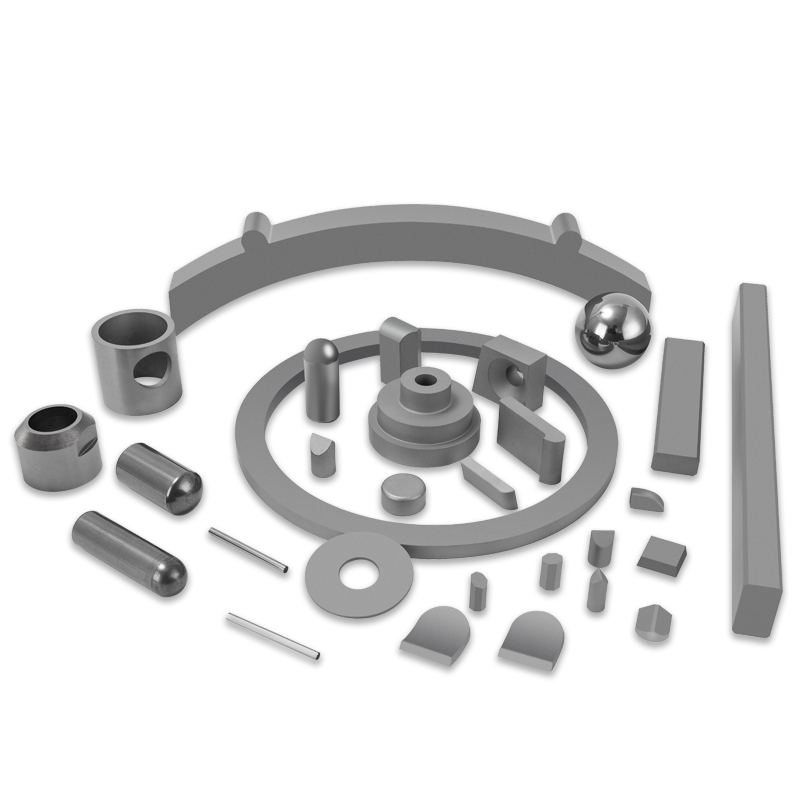
Key Components of a Tungsten Carbide Stamping Die Assembly
A complete carbide stamping die is not simply a single piece of carbide — it's a precision assembly of multiple components, each engineered to work in concert. Understanding the functional role of each part helps with both die design decisions and fault diagnosis when problems arise in production.
Carbide Punch (Upper Die)
The carbide punch is the active cutting or forming member that descends with the press ram. It defines the shape being stamped — round, square, complex profile, or custom contour — and its cutting edge geometry determines burr height and edge quality on the finished part. Punches are typically press-fit or mechanically retained into a steel punch holder, with the carbide tip doing all the work at the cutting face. Punch length, cross-sectional area, and edge relief angle all factor into how long the punch maintains its geometry before regrinding is required.
Carbide Die Button (Lower Die)
The die button is the stationary lower cutting member. The punch enters the die button opening with a controlled clearance — typically 5–10% of material thickness per side for blanking operations — and this clearance gap is what shears the material cleanly. Carbide die buttons are press-fit into a steel die shoe or die plate. The land length (the vertical height of the parallel cutting section before the die relief angle begins) affects both cutting force and die life — longer land increases wear resistance but also increases stripping force.
Die Clearance and Its Effect on Part Quality
Proper punch-to-die clearance is one of the most critical variables in carbide stamping die performance. Too little clearance increases cutting force, generates excessive heat, and accelerates edge wear on both punch and die. Too much clearance produces a larger rollover zone, taller burrs, and reduced dimensional accuracy on the sheared edge. For soft materials like copper or aluminum, tighter clearances (4–6% per side) produce cleaner cuts. For harder or thicker materials, wider clearances (8–12% per side) reduce tool stress and extend die life.
Guide Pillars and Bushings
Precision guide pillars and bushings maintain accurate alignment between the upper and lower die halves throughout every press stroke. Misalignment — even a few microns — causes uneven loading on carbide cutting edges, accelerating edge chipping and reducing die life. In high-speed stamping applications, ball cage guide systems replace plain bushings for reduced friction and more precise guidance at elevated speeds.
Manufacturing Methods: How Tungsten Carbide Stamping Dies Are Made
The manufacturing process for tungsten carbide stamping dies is more complex and specialized than for tool steel tooling. Understanding the production methods helps buyers evaluate supplier capability and set realistic lead time expectations.
Powder Metallurgy and Sintering
Tungsten carbide die blanks are produced by powder metallurgy — blending WC powder with cobalt binder, pressing the mixture into near-net shape, and sintering at temperatures around 1,400–1,500°C under vacuum or inert atmosphere. During sintering, the cobalt melts and flows between WC grains, creating a dense, homogeneous matrix. The sintered blank shrinks predictably (typically 18–20% linear) from the pressed shape, and this shrinkage factor is accounted for in the pre-sintering dimensions. Blank quality — porosity level, grain uniformity, and binder distribution — determines the ceiling on achievable die performance.
EDM (Electrical Discharge Machining)
Because sintered tungsten carbide is too hard to machine with conventional cutting tools, complex profiles are machined using EDM (wire EDM or sinker EDM). Wire EDM cuts through the carbide blank using a travelling wire electrode and electrical discharge erosion, producing very precise contour shapes with tolerances of ±0.002–0.005mm on profile dimensions. Sinker EDM uses shaped electrodes to erode three-dimensional cavity features. EDM surface layers on carbide must be carefully controlled and often require post-EDM polishing to remove any heat-affected recast layer that could act as a crack initiation site under cyclic loading.
Diamond Grinding and Lapping
Final dimensional accuracy and surface finish on carbide stamping dies are achieved through diamond wheel grinding — the only abrasive hard enough to efficiently machine tungsten carbide. Surface grinding, cylindrical grinding, and profile grinding with resin- or metal-bond diamond wheels bring die components to final tolerance. Critical cutting edges and mating surfaces are then lapped with diamond compound to achieve surface finishes below Ra 0.1μm, which is essential for minimizing adhesive wear and achieving clean sheared edges on stamped parts.
Maintenance and Regrinding: Extending Tungsten Carbide Die Life
One of the practical advantages of tungsten carbide stamping dies over tool steel is that worn cutting edges can be reground multiple times before the die reaches end of life — as long as regrinding is done correctly and at the right intervals. A poorly maintained carbide die, however, can fail catastrophically and destroy the substrate or downstream parts.
When to Regrind: Recognizing Wear Signs
- Increasing burr height: As cutting edges dull, the shear zone widens and burr height on the stamped part increases. Establish a burr height threshold (e.g., 10% of material thickness) and trigger regrinding when parts consistently exceed it.
- Increased stripping force: A worn or chipped punch edge creates more friction during material stripping, which shows up as elevated press load readings or stripping spring fatigue.
- Visible edge rounding or chipping under magnification: Regular inspection of cutting edges under a loupe or optical comparator catches chipping before it propagates into larger edge fractures that require more aggressive material removal to fix.
- Dimensional drift on stamped parts: As die clearance effectively increases due to edge wear, part dimensions shift. Monitor critical dimensions on a statistical basis and use trend data to predict when regrinding is due before scrap rates climb.
Correct Regrinding Practice
Regrinding tungsten carbide requires diamond wheels with appropriate bond hardness and grit size for the carbide grade being ground. Use coolant flood throughout grinding to prevent thermal damage — localized overheating during regrinding creates tensile residual stress and micro-cracking at the surface that dramatically reduces subsequent die life. Remove only as much material as needed to restore a clean, sharp edge — typically 0.05–0.15mm per regrind cycle. Track cumulative material removed from punch length to know how many more regrind cycles remain before the punch is too short for safe use.
What to Look for When Sourcing a Tungsten Carbide Stamping Die Supplier
Sourcing carbide stamping dies involves more variables than buying commodity tooling. A few key evaluation criteria separate suppliers who consistently deliver long-life, high-precision dies from those who produce inconsistent quality that fails in service.
- In-house raw material sourcing: Suppliers who purchase sintered carbide blanks from certified raw material producers — rather than unknown spot-market sources — can trace material grade and batch quality. Ask for carbide material certificates and confirm cobalt content and grain size match the specified grade.
- Wire EDM and grinding capability: Confirm the supplier operates their own EDM and diamond grinding equipment rather than outsourcing these critical steps. Each handoff between subcontractors introduces dimensional risk and reduces accountability for final die accuracy.
- Inspection and measurement capability: Quality carbide die suppliers use CMM (coordinate measuring machine) inspection to verify critical dimensions, optical comparators for profile verification, and surface roughness testers to confirm ground surface finish. Ask what inspection records are provided with each die shipment.
- Application engineering support: The best carbide die suppliers don't just manufacture to your drawing — they review it for potential design issues before cutting material. Experience with clearance recommendations, grade selection for your specific material and application, and edge geometry optimization is genuinely valuable and separates specialist toolmakers from general machine shops.
- Lead time and regrinding service: For production-critical tooling, confirm the supplier's standard and expedited lead times for both new dies and regrinding service. A supplier who can turn around a regrind within 24–48 hours dramatically reduces your production downtime exposure compared to one with a two-week queue.
Our Products //
Related Products

If you are interested in our products, please consult us
